$\newcommand{\dede}[2]{\frac{\partial #1}{\partial #2} }
\newcommand{\dd}[2]{\frac{d #1}{d #2}}
\newcommand{\divby}[1]{\frac{1}{#1} }
\newcommand{\typing}[3][\Gamma]{#1 \vdash #2 : #3}
\newcommand{\xyz}[0]{(x,y,z)}
\newcommand{\xyzt}[0]{(x,y,z,t)}
\newcommand{\hams}[0]{-\frac{\hbar^2}{2m}(\dede{^2}{x^2} + \dede{^2}{y^2} + \dede{^2}{z^2}) + V\xyz}
\newcommand{\hamt}[0]{-\frac{\hbar^2}{2m}(\dede{^2}{x^2} + \dede{^2}{y^2} + \dede{^2}{z^2}) + V\xyzt}
\newcommand{\ham}[0]{-\frac{\hbar^2}{2m}(\dede{^2}{x^2}) + V(x)}
\newcommand{\konko}[2]{^{#1}\space_{#2}}
\newcommand{\kokon}[2]{_{#1}\space^{#2}} $
# Content
$\newcommand{\L}{\mathcal L}$
$\newcommand{\lrangle}[1]{\langle #1 \rangle}$
$\newcommand{\xton}[1]{x_{1}, \ldots, x_{#1}}$
$\newcommand{\pmatrix}[1]{ \begin{pmatrix} #1 \end{pmatrix}}$
$\newcommand{\ad}{{\hat{a}^{\dagger}}}$
$\newcommand{\a}{\hat{a}}$
## Lecture:
### Entanglement & non-signaling
When combining quantum system, our formalism tells us to simply create the tensor product of the two states.
Our formalism does not care how far away those two systems are.
Sometimes we can treat one system, without actually knowing what is going on on the other system. We call such systems separable.
Mathematically a state is separable if we can write it as:
$$\ket \psi = \ket \phi_{A} \otimes \ket \phi_B$$
Note that sometimes we need to reformulate to get to this result:
for example:
$$
\ket \psi = \ket{01} + \ket{10} + \ket{11} + \ket{00} = (\ket{0} + \ket{1}) \otimes (\ket{0} + \ket{1})
$$
If a system state is _not separable_ we call it entangled.
#### Bell states
The most prototypical case of entangled states are the so-called bell-states.
$$\ket \psi_{1} = \frac{1}{\sqrt{2}} (\uparrow\uparrow + \downarrow\downarrow)$$
$$\ket \psi_{2} = \frac{1}{\sqrt{2}} (\uparrow\uparrow - \downarrow\downarrow)$$
$$\ket \psi_{3} = \frac{1}{\sqrt{2}} (\uparrow\downarrow + \downarrow\uparrow)$$
$$\ket \psi_{4} = \frac{1}{\sqrt{2}} (\uparrow\downarrow - \downarrow\uparrow)$$
Note that while they are individually entangled, sums of these are not necessarily entangled.
Note for example:
$\ket \psi_{1} + \ket \psi_{2} = \uparrow\uparrow = \uparrow \otimes \uparrow$
#### Density operator
We have previously seen density operators in the field-theoretic sense. There it described the probability of finding a system in certain states.
We can do the same, but replacing the position-fock basis with an arbitrary reference basis.
We end up with
$$\rho = \sum\limits p_{i}\ket \psi_{i} \bra \psi_{i}$$
As an observable it does two things:
1) It projects onto the reference basis
2) It weights the projection with a probability
What this means is that we can encode into $\rho$ a statistical distribution of states we believe our system is in.
##### Example:
The broken experiment.
Imagine we built in our lab the perfect setup to create bell states (yipee!)
Upon pressing a button we can deterministically create:
$\ket \psi = \frac{1}{\sqrt{2}}(\uparrow \uparrow + \downarrow \downarrow)$
However, what we did not notice is that while we were away on the weekend, a lab-rat escaped from the neighboring bio lab, and chewed through our cable.
Now only half of the time the signal to create a bell state is sent to the exeriment.
In case there is no such signal sent the experiment will simply produce: $\uparrow \uparrow$
We still want to characterize what state our system is in.
We write the density operator as follows:
$\rho_{bell}= \ket{\psi_{bell}}\bra{\psi_{bell}} = \frac{1}{2} \big(\ket{\uparrow\uparrow}\bra{\uparrow\uparrow}) + \ket{\uparrow\uparrow}\bra{\downarrow\downarrow}) + \ket{\downarrow\downarrow}\bra{\uparrow\uparrow}) + \ket{\downarrow\downarrow}\bra{\downarrow\downarrow})\big)$
$\rho_{fail}= \ket{\uparrow\uparrow} \bra{\uparrow\uparrow}$
$$\rho_{tot} = \rho_{bell}p_{bell}+ \rho_{fail}p_{fail}$$
With $p_{b} +p_{f}= 1$
Thus we get
$\rho_{bell}= \ket{\psi_{bell}}\bra{\psi_{bell}} = \frac{1}{4} \big(2\ket{\uparrow\uparrow}\bra{\uparrow\uparrow} + \ket{\uparrow\uparrow}\bra{\downarrow\downarrow} + \ket{\downarrow\downarrow}\bra{\uparrow\uparrow} + \ket{\downarrow\downarrow}\bra{\downarrow\downarrow})\big)$
#### Non-signaling
For those that have not done the homework we can quickly go over non-signaling.
First, why would we expect signaling?
Well if we consider that we have entangled states, a measurement on one side will collapse the state on the other side imediately.
This seems like instant communication.
And was called "spooky action at a distance".
However what we can show is that this collapse contains no usable information.
The idea is that while the wavefunction can be made to collapse instantaniously, the state it collapses into is indistinguishable from the other state it could have collapsed to.
Only once we get the context of the measurement from the far away party, can we deduce which of the two signals we should have gotten.
This means while collapse travels faster than light, information does not.
## Repetition
### Scattering
#### Classical scattering:
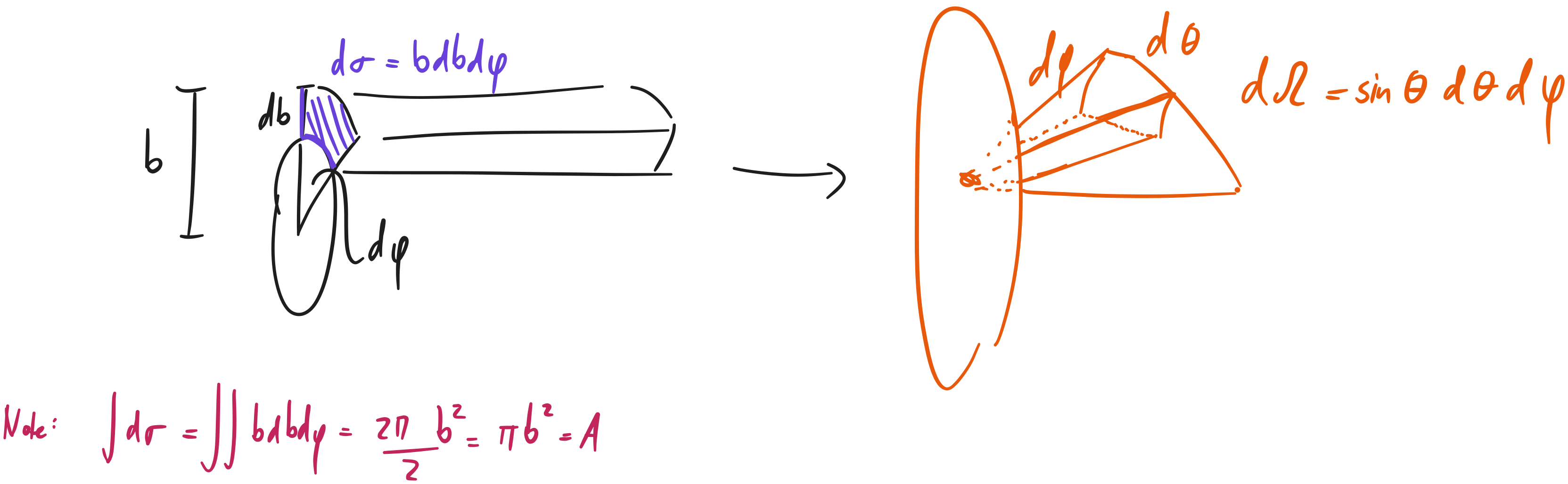
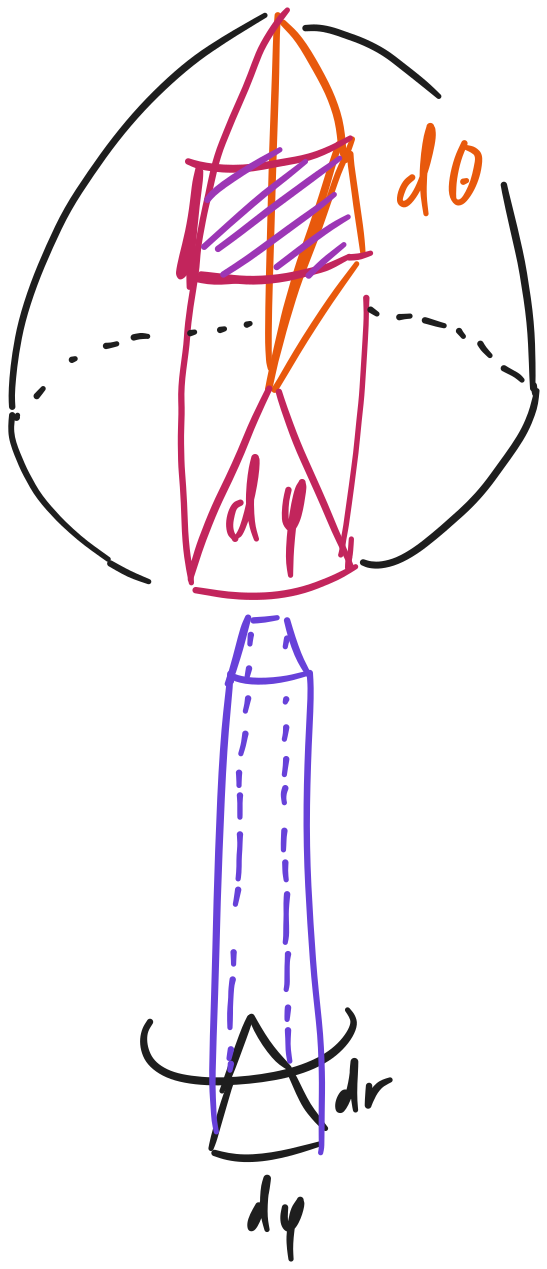 The main idea behind scattering theory is mapping the geometry of an input scatterer to the geometry of the output.
For this we first consider a ray of particles hitting a fixed object.
We see that the beam is best characterized by cylindrical coordinates. While the outgoing scattering is best characterized by a sphere.
We now even note that the cylinder will be fully rotational symmetric, thus we average away our $\phi$ coordinate.
The only remaining coordinates are $b$ the impact parameter and $\theta$ the scattering angle.
#### The lippman schwinger equation
(in the born approximation)
$$\psi_{k}= e^{ikx} + \frac{e^{ikr}}{r}f(k,k')$$
This means that the wavefunction that solves the scattering is an incoming planewave and an outgoing radial wave, which is shaped by the k vectors.
For fixed $|k|$ and $|k'|$ we can think of $f$ as a function, that gives the output shape for a fixed frequency input and output.
When we think about scattering a wave off of an object, it makes sense that we would like to encode the process in k-space.
It turns out that the scattering amplitude $f$ can then be easily written as the fourier transform of the potential.
$f(k,k') = - \frac{m}{2\pi\hbar^{2}}\tilde V(k' - k)$
More precisely:
To get to the fourier transform result we start with the original lipman schwinger equation
$$\psi_{\vec k} (\vec x) = \int dy G_{\vec k} (\vec x - \vec y) V(\vec y) \psi_{\vec k} (\vec y) + \underbrace{e^{i\vec k \vec x}(\vec x)}_{\phi}$$
This equation is often also written as:
$$\ket \psi = \frac{1}{E-H_{0}+i\varepsilon} V \ket \psi + \ket \phi $$
In the common form the integral part is hidden in the "division by an operator". The $i\varepsilon$ is a convergence inducing factor, which we skip because we evaluate the the contour integral explicitly.
To get to our solution we can use the resolution of identiy using momentum states:
$$\ket \psi = \frac{1}{E-H_{0}+i\varepsilon} \int dk \ket k \bra k V \ket \psi + \ket \phi $$
$$\ket \psi = \int dk \frac{1}{E-E_{k} \pm i\varepsilon} \ket k \bra k V \ket \psi + \ket \phi $$
We need to cheat slightly on the prefactor of $i\varepsilon$ because we need the freedom to choose it so that it is dampening. (depending on whether we solve incoming or outgoing/ forwards in time vs backwards in time systems).
Anyways we write the "LS-application operator" $K$, which just applies the "complicated" part of the LS equation to the state.
We can then write the LS equation simply as:
$$\ket \psi = K\ket\psi + \ket \phi$$
We can infinitely plug in $\psi$ into the equation.
If we say we plug it in only once we get:
$\ket \psi = (1+K)\phi$
This is the born approximation.
Now the LS-application operator will act on $\phi$, it turns out that this operator is exacly the ft. (because we switch to the momentum basis)
### PI
##### Repe lagrangian formalism (classical)
Given a lagrangian: $\mathcal L = T-V = \frac{1}{2}mv^{2} - \frac{1}{2}kx^{2}$
We know that the path $x(t)$ the system takes will minimize the action
$$S[\gamma] = \int_{\gamma} L(x,x',t) d\gamma$$
Using variational calculus we can deduce the euler lagrange equations from this:
$$\dd{}{t} \dede{L}{q'} = \dede{L}{q} $$
In this case we can plug in $\mathcal L$ to get:
$$\dd{}{t} mv = -kx$$
This is the well known equation of motion for the harmonic oscillator
$$ mx'' = -kx$$
Which we can solve via FT
$$ -\omega^{2}m\tilde x = -k\tilde x$$
$\omega =\sqrt{ \frac{k}{m}}$
##### Idea of variational calculus:
We assume we already found $\gamma_{opt}$. Now we make a $\epsilon$ perturbation of $\gamma_{opt}$ for this we take the perturbing function $h$ which can be arbitrary, but has to be zero at the edges.
$$S[\gamma + \epsilon h]$$
Now we know that because $\gamma$ is optimal, a small perturbation in $h$ should not matter:
We thus write:
$$\dd{S[\gamma + \epsilon h]}{\epsilon}|_{\epsilon=0} = 0$$
Pulling the derivative into the integral we will find something that in a product with $h$ will be zero.
Now because the integral is zero, and $h$ is arbitrary, that other thing needs to be zero.
That other thing will be exactly the condition for the ELG equations.
### Lie theory for QM:
- Clebsh gordan
- Campbell baker hausdorff
## Kahoot
The main idea behind scattering theory is mapping the geometry of an input scatterer to the geometry of the output.
For this we first consider a ray of particles hitting a fixed object.
We see that the beam is best characterized by cylindrical coordinates. While the outgoing scattering is best characterized by a sphere.
We now even note that the cylinder will be fully rotational symmetric, thus we average away our $\phi$ coordinate.
The only remaining coordinates are $b$ the impact parameter and $\theta$ the scattering angle.
#### The lippman schwinger equation
(in the born approximation)
$$\psi_{k}= e^{ikx} + \frac{e^{ikr}}{r}f(k,k')$$
This means that the wavefunction that solves the scattering is an incoming planewave and an outgoing radial wave, which is shaped by the k vectors.
For fixed $|k|$ and $|k'|$ we can think of $f$ as a function, that gives the output shape for a fixed frequency input and output.
When we think about scattering a wave off of an object, it makes sense that we would like to encode the process in k-space.
It turns out that the scattering amplitude $f$ can then be easily written as the fourier transform of the potential.
$f(k,k') = - \frac{m}{2\pi\hbar^{2}}\tilde V(k' - k)$
More precisely:
To get to the fourier transform result we start with the original lipman schwinger equation
$$\psi_{\vec k} (\vec x) = \int dy G_{\vec k} (\vec x - \vec y) V(\vec y) \psi_{\vec k} (\vec y) + \underbrace{e^{i\vec k \vec x}(\vec x)}_{\phi}$$
This equation is often also written as:
$$\ket \psi = \frac{1}{E-H_{0}+i\varepsilon} V \ket \psi + \ket \phi $$
In the common form the integral part is hidden in the "division by an operator". The $i\varepsilon$ is a convergence inducing factor, which we skip because we evaluate the the contour integral explicitly.
To get to our solution we can use the resolution of identiy using momentum states:
$$\ket \psi = \frac{1}{E-H_{0}+i\varepsilon} \int dk \ket k \bra k V \ket \psi + \ket \phi $$
$$\ket \psi = \int dk \frac{1}{E-E_{k} \pm i\varepsilon} \ket k \bra k V \ket \psi + \ket \phi $$
We need to cheat slightly on the prefactor of $i\varepsilon$ because we need the freedom to choose it so that it is dampening. (depending on whether we solve incoming or outgoing/ forwards in time vs backwards in time systems).
Anyways we write the "LS-application operator" $K$, which just applies the "complicated" part of the LS equation to the state.
We can then write the LS equation simply as:
$$\ket \psi = K\ket\psi + \ket \phi$$
We can infinitely plug in $\psi$ into the equation.
If we say we plug it in only once we get:
$\ket \psi = (1+K)\phi$
This is the born approximation.
Now the LS-application operator will act on $\phi$, it turns out that this operator is exacly the ft. (because we switch to the momentum basis)
### PI
##### Repe lagrangian formalism (classical)
Given a lagrangian: $\mathcal L = T-V = \frac{1}{2}mv^{2} - \frac{1}{2}kx^{2}$
We know that the path $x(t)$ the system takes will minimize the action
$$S[\gamma] = \int_{\gamma} L(x,x',t) d\gamma$$
Using variational calculus we can deduce the euler lagrange equations from this:
$$\dd{}{t} \dede{L}{q'} = \dede{L}{q} $$
In this case we can plug in $\mathcal L$ to get:
$$\dd{}{t} mv = -kx$$
This is the well known equation of motion for the harmonic oscillator
$$ mx'' = -kx$$
Which we can solve via FT
$$ -\omega^{2}m\tilde x = -k\tilde x$$
$\omega =\sqrt{ \frac{k}{m}}$
##### Idea of variational calculus:
We assume we already found $\gamma_{opt}$. Now we make a $\epsilon$ perturbation of $\gamma_{opt}$ for this we take the perturbing function $h$ which can be arbitrary, but has to be zero at the edges.
$$S[\gamma + \epsilon h]$$
Now we know that because $\gamma$ is optimal, a small perturbation in $h$ should not matter:
We thus write:
$$\dd{S[\gamma + \epsilon h]}{\epsilon}|_{\epsilon=0} = 0$$
Pulling the derivative into the integral we will find something that in a product with $h$ will be zero.
Now because the integral is zero, and $h$ is arbitrary, that other thing needs to be zero.
That other thing will be exactly the condition for the ELG equations.
### Lie theory for QM:
- Clebsh gordan
- Campbell baker hausdorff
## Kahoot